Sunday, August 1, 2010

8. Suite: Judy Blue Eyes - (Crosby, Stills, Nash & Young)


"Don't let the past remind us of what we are not now."

Dang, what an inspired line.

Has there ever been a more well-conceived and well-concealed breakup song than Steven Stills' "Suite: Judy Blue Eyes?" For my money, this soaring seven-minute epic is quite possibly one of the smartest pop songs ever written. Rolling Stone seems to agree -- they named it as one of the top 500 songs in all of rock and roll history.

Although, if you wanna' get technical -- it's actually more like *four* miniature songs in one (needless to say, today's post will be a bit longer than most). But yeah, four-in-one -- such is the beauty of a "suite:" a collection of loosely affiliated sub-portions of one, larger whole.

Now if this was a strict poem, we'd probably group this under the same "theme with variations" category as Yeats' "Crazy Jane" writings (which we talked about here). Or perhaps we'd lump it in with the lesser-known subgenre of the sonnet crown: a seven-poem set written on a single subject (usually, a lover) where each new sonnet borrows a line or two from the last one in order to explore a different aspect of the original topic.
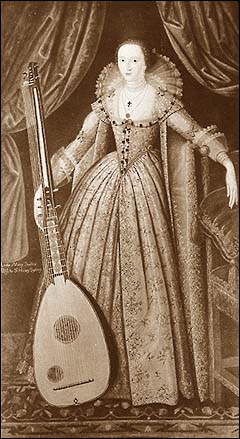

How YOU doin', Lady Mary Wroth?

But anyway -- getting back to good old "Suite: Judy Blue Eyes"...

Our boy Steven Stills reportedly penned this not-so-little-ditty just as his relationship with the venerable Judy Collins was hitting the skids. Basically, he knew that a breakup was imminent, and so he sat down and banged out four demo songs in quick succession to tell her how he was feeling about the whole thing.

And when you think about just about any breakup you've ever had (especially the really complicated ones), it's kinda' hard to fault the guy for churning out multiple musings on the exact same event. Dude's got a lot to say, after all. And Judy Collins was quite a catch (well, I mean, at the time). Heck, when your emotions are all over the map -- four songs might even fall short of covering the full gamut, right?

Right.

Now then, let's see just how broad this spectrum of subtext can be. Accordingly, we'll proceed to the sub-song(s), in order:


MINI SONG NUMERO UNO: "I am yours, you are mine, you are what you are..."

This first section is the most conventionally "pop" of the whole lot. It's structured around a simple, repeating chorus, written from the perspective of the soon-to-be-used-to-be-boyfriend, and it recalls just how stale things have gotten between the couple ("It's getting to the point / where I'm no fun anymore") in spite of their best efforts. The poppy guitar helps mask the inherent sadness of the ordeal -- but the text (much like Shakira's hips) don't lie.

In other words: "no hard feelings, sweetie... but we're done here."

Fittingly, this section wraps with the repeated incantation: "you make it hard," as if to say "I know what I *have* to do... but dayyyum, gurrrl -- you sure don't make this any easier."


MINI SONG NUMERO DOS: "What have you got to lose?"

Ever have that "one last makeout session," or a wild night of breakup sex?

Ladies and gentlemen, welcome to song numero dos (which kicks off at just around 2 minutes and 50 seconds in, or so). Sure, old Stevie Stills made up his mind to call it quits in the first chunk of the song -- and once again here, he reiterates his decision and tells Miss Judy Blue Eyes to hit the bricks ("Tuesday mornin', please be gone -- I'm tired of you"). But then throughout this slower, second section, he seems to second-guess himself:

"What have you got to lose?"
Do we break it or do we give it a shot? Do we try and stay friends and keep seeing each other, or do we rip that Band-Aid right off and go our separate ways? Dang, if only things could be so cut-and-dry. Or, to borrow a line from Macbeth:


"If it 'twere done when 'tis done, then 'twere well it were done quickly."
- Macbeth: Act I, Scene vii

Ahh breakups.

('ish just got real...)


SONG NUMERO TRES:
Gratuitous poetry? You know it.
Steven Stills was emo before emo was cool. And like any self-respecting emo kid -- at the first sign of self-doubt, he paints his fingernails black feels the immediate need to launch headlong into a full-blown maze of deep, obscure and introspective poetry.

Case in point, right around 4:43 into the song:

Chestnut brown canary / Ruby throated sparrow
Sing the song, don't be long / Thrill me to the marrow

Voices of the angels, ring around the moonlight / Asking me, said she so free
How can you catch the sparrow?
WTF?

THIS MEANS NOTHING.

Well okay, maybe not "nothing" -- but it's a pretty clear indication that there's a whole lotta' big issues swirling around all at once, and our songwriter's attitude has clearly shifted away from one of:
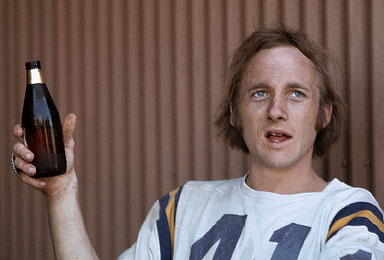

"Relax, man, I totally got this..."

to one of...
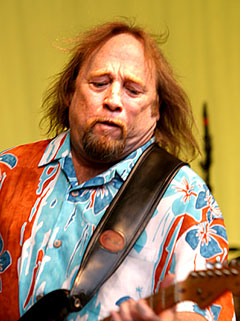

"Dude, I have *NO* clue what's going on here (ps: cocaine's a helluva drug)."

SONG NUMERO CUATRO (or is that "catorce?"): Nonsensical Spanish -- GO!
Bono wasn't the first rock star to butcher the Spanish language. In fact, the guys from CSN&Y beat him by a good forty years or so with the nonsensical mishmash that closes out "Suite: Judy Blue Eyes." Here, take a look at the closing lyrics to this song (6:25 to the end):

Que Linda me la traiga cuba
La reina de la mar caribe
Cielo sol no tiene sangre alli
Y que triste que no puedo vaya
Oh va, oh va, va
For those of y'all who don't quite habla Espanol, a rough translation -- courtesy of Babelfish:
Such beauty brings me back to Cuba
The queen of the Caribbean Sea
Sky, the sun has no blood there
And how sad that I cannot go.
Oh, go! Oh, go!
Whoah whoah whoah -- wait, what? So he's in Cuba now? And the sun has... bled itself dry?

Even with the most liberal of translations, we're looking at something that barely passes for "English" here. The individual words? Maybe. But the sentences? Not so much.

The balladeer has gotten so caught up in everything that he's completely lost sight of what all he was talking about in the first place. The cheery music helps mask the message, but in four short movements (and in just under seven minutes time), he's gone from knowing where he stands to jabbering virtual nonsense -- in a garbled hodgepodge of Spanish, no less. Style imitates substance: the audience can barely understand the songwriter because he can barely understand himself.

Say --

Remember waaaaaay back in the beginning of this post when we called "Suite: Judy Blue Eyes" one of the smartest pop songs ever written?

Neat :)

Thursday, July 1, 2010

7. When I Dream of Michelangelo - (Counting Crows)


"And he seems so close as he reaches out his hand /
We are never quite as close as we are led to understand."


Ahh, Adam Duritz. Self-proclaimed Rain King and modern-day master of the metaphor.

I mentioned it in passing in
the last blog entry, but this is precisely the kind of song that T.S. Eliot would love. After all, Eliot practically wrote it in the first place, ya' know. But perhaps imitation is indeed the sincerest form of flattery. Or as the poet himself once so famously put it:


"Mediocre writers borrow. Great writers steal."

Make no mistake about it -- the Counting Crows' "When I Dream of Michelangelo" is an undeniably *great* song, but it is just as undoubtedly a stolen one, to boot.

Stolen from source numero uno: Their own freakin' catalogue.

Longtime fans of the band might recognize this song's title as something of a throwaway line from an earlier Counting Crows track, titled "Angels of the Silences," which appeared as the first single off of the group's second album waaaaaay back in 1996. For the sake of historical accuracy, that lyric went a little something like this:

"I dream of Michelangelo when I'm lyin' in my bed
Little angels hang above my head and read me like an open book..."
Turns out Adam Duritz has been dreaming of Michelangelo for a good, long while, but it took him a full 13 years to hammer out just exactly what this dream just so happened to mean. This probably explains why the line has snuck into more than one of his songs.

So what does it mean?

His latest explanation (courtesy of a quite-possibly-chemically-enhanced deluge of pre-song stage chatter):

"When I dream of Michelangelo" is a story about spending your whole life wanting for something. Like a child in a cradle who sleeps underneath a spinning mobile; from the moment we are born, we can't help but find ourselves reaching for something that just seems to elude our grasp. A mobile. A dream. A girl. A painting -- you name it. You spend your whole life chasing after this one thing.

On rare occasion, we might even capture it and make something truly great in the process (kinda like the ceiling of Sistine Chapel, for example). But for the most part, all of our reaching really doesn't make a lick of difference, and so we end up losing sight of everything around us along the way. Sure, it may have *felt* like we were just seconds away from finally getting it right. But maybe (just maybe?) -- it was never really all that close to begin with.


Ouch.

Ah well -- lesson learned, and I supposed we'll take the message to heart and move on all the wiser next time. Don't spend your life staring at the ceiling. Don't let the same girl break your heart twice. And "don't get fooled again" right?

Not so fast.

See the funny thing about patterns is that they usually end up repeating themselves if you wait long enough. Or as Adam sings:

"And I know that she is not my friend.
And I know...
[but] there she goes walkin' on my skin again and again."
Hey now wait just a second here -- a lovestruck protagonist who stares at Michelangelo but keeps finding himself distracted by the same heartbreaker over and over again?


Hey whaddayaknow... we're right back to T.S. Eliot and J. Alfred Prufrock (1917)

Thematically, Eliot and Duritz are handling the exact same subject material: longing, self-awareness, and self-doubt. And to top it all off, both artists have a thing for Michelangelo, to boot. Take a look at this twice-repeated excerpt from Eliot's poem:

"In the room the women come and go
Talking of Michelangelo."
(Toldja' the song was stolen.)
Stolen from source numero dos: "The Love Song of J. Alfred Prufrock"
Adam Duritz may well have been dreaming of Michelangelo for the better part of fifteen years, but he was hardly the first man in history to watch an existential crisis unfold while pondering the mysteries of a pizza-loving hero on a half-shell.

Prufrock's poem takes us smack-dab through the middle of an art gallery, so the narrator can't help but weigh his own indecisive self-worth against the sheer size, grandeur, and impressiveness of the monuments that surround him. As "the women come and go" while chit-chatting about just how gosh-darned great this Michelangelo feller is (and let's be honest here, he is pretty flippin' amazing) -- Prufrock retreats further and further into himself, ever reminded of his own failures.

So close... but so very, very far.

Time and again, Prufrock *almost* seems to build up the courage to say what he means -- but without fail, he ends up second-guessing his own resolve, and things fall apart. Just like Adam Duritz can't seem to kick this tendency to let this girl who's "not my friend" come right back into his life and start "walking on [his] skin again and again," J. Alfred Prufrock finds himself similarly plagued by indecision, saying:

That is not it at all,
That is not what I meant, at all.
In the last blog entry (you know, the rockin' good time that was excerpted from the Counting Crows' "Saturday Nights" collection), we looked at how these two protagonists mused openly on their similarly unrealized and violent potential. Here's a one-liner recap:
Duritz: "I wanted to change the world. What's as easy as murder?"
Prufrock: "There will be time to murder and create."
Today, we've entered the "Sunday Morning" side of the spectrum -- a period of quietude and reflection. The violence may have dissipated, and the anger may well be gone, but the sense of self-doubt and longing still weighs heavy on the heart. Duritz has learned a valuable lesson only to turn right back around and forget it. And Prufrock has "seen the Eternal footman hold [his] coat and snicker."

"In short, [he] was afraid."

Like Prufrock, the Counting Crows frontman "seems so close as he reaches out his hand...." But in the same vein as Eliot before him, Duritz' deep-seated longing remains in spite of his newfound self awareness. It's something of a paradox, really. After all:

"We are never quite as close as we are led to understand."

Tuesday, June 1, 2010

6. Cowboys - (Counting Crows)


"This is a list of what I shoulda' been / but I'm not... "

Last week, an old friend of mine commented on the contents of this blog (hooray! Someone is actually reading this darned thing!). His exact quote?

"dude, you might not have heard, but a few new albums have been released since we were in college. What's with all the nostalgia?"
Fair enough, and point taken. And since you asked so nicely... I'll tell you what I'm gonna' do: JUST FOR YOU! -- we're flashing forward right up through 2008, and we'll be spending the next two (count 'em, TWO!) entries tackling an outstanding pair of tracks from Saturday Nights and Sunday Mornings, the latest studio effort by the staggeringly talented tribe of troubadours known as the Counting Crows.

Here's the scoop on the
SN&SM album:

Whereas so many of their mid-nineties alt-rock contemporaries have faded into obscurity (remember Seven Mary Three? Didn't think so), Adam Duritz and the gang have kept pumping out quality new material even now, well over a decade and a half after the release of their breakthrough
August and Everything After first arrived in 1993. Their latest release is a mix of hard-driving rock songs and a country-infused array of introspection. It's fast, it's slow -- it's new, and yet it's familiar all at the same time. In short? It's the same old Counting Crows.

But they've certainly come a long way since "Mr. Jones."
Adam Duritz: For the last time, NO -- that song is *not* about my penis.
Saturday Nights and Sunday Mornings is a clever little double album (of sorts). Even though there's only enough material on the disk to fill a scant 80 minutes, the tracks are divided thematically between six edgier, "Saturday Night" rock & roll songs and the eight slower, more contemplative "Sunday Morning" ballads that close out the set. Effectively, this is the artist's way of telling fans:

"Saturday nights are for rockin' -- Sunday mornings are for reflection."

Say... I kinda' like that. After all, you can't have one without the other, right?

So over the next two blog posts, we'll be tackling the two tracks that best exemplify each of these same phases, respectively. And fittingly (since the tracks are, in fact, no more than divided halves of the same, larger, and themeatically unified piece) -- we'll likewise be sizing them up against an equally complex, divided, and giant-sized poetic predecessor by none other than the late, great T.S. Eliot.

Today's track? The crescendo of the hard-driving "
Saturday Nights" chapter. An awesome little song called "Cowboys:"
No, not you, Tony. You are the antithesis of awesome. PS: Die in a fire.
- Everyone


Now then -- to the Counting Crows' "Cowboys." And boy, does this one hit the ground running:

"Cowboys on the road tonight, cryin' in their sleep /
If I was a hungry man with a gun in my hand /
There's some promises to keep..."
Right off the bat, there's no denying it: Adam is *PISSED*. Dude is storming through the streets, contemplating "what's as easy as murder" and brandishing a firearm. The adrenaline is pumping. His mind is racing. And bidness is about to pick right on up in a hurry. Heck, before the night is through? It looks as if our ever-doleful vocalist might just be fixin' to put a bullet in somebody else's head.

(Or worse -- his own).

See this is why Cowboys is such a fantastic piece -- throughout the song, we've got these hard, driving guitar riffs and these desperately embittered vocals. So naturally, we're supposed to think that something wicked this way comes, and our boy Adam Duritz is just one verse away from shooting a man in Reno just to watch him die, yes?

No.

Because when you look at the lyrics, there's a whole lotta' "if," "and," and "but" scattered at every turn -- which totally undermines the song's otherwise strident intentions. Sure, the singer's got some serious (and perhaps indeed violent) passions bubbling right there underneath the surface, but he never can quite seem to bring himself to act on these motives in spite of himself, which means we're left with lines like this:
"This is a list of what I shoulda' been, but I'm not.
This is a list of what I shoulda' seen, but I am not seein'
...
I'm just turning away from what I shouldn't see
Because I am not anything."
He wants to make a difference, but he can't. He's dying to make a change, but he won't. He's got the best (and worst!) of intentions, but zero capacity to act on them. In other words --

Adam isn't a cowboy... he's a coward. Kinda like...

T.S. Eliot: a.k.a. J. Alfred Prufrock

What's that? You haven't read "The Love Song of J. Alfred Prufrock, " you say? Humbug. Thankfully, that's what the internet is for.
Go ahead, I'll wait.

(Alternately: here's a quick recap):

J. Alfred Prufrock: a man with the best of ideas, but zero ability to bring them to life. Has a massive crush on pretty much every woman who passes by his way, but he can't make a decision for the life of him, and so he's forced to sit back and watch as life unfolds around him, all while making ridiculous mountains out of even the tiniest of life's incidental molehills (e.g. -- "which way to part my hair?" "Trousers: rolled, or unrolled?" "Do I dare eat a peach!?" etc.).

Like our buddy Adam Duritz, Eliot's alter-ego is loaded with passion (it's kinda' heartbreaking, actually), but he remains absolutely crippled by the words that he can't quite ever bring himself to say. So instead of doing something about it, he chickens out and writes his thoughts down on the page, and we see just how sad and screwed up the poor guy really is. Riddled with indecision, Prufrock looks at his life as a waste:
"I should have been a ragged pair of claws / Scuttling across the floors of silent seas...
In short, he thinks his existence would have been better spent if he were a hermit crab. He's the type of dude who might make "a list of what I shoulda' been but I'm not."

And why?
"Because I am not anything."
Man, talk about your self-confidence issues.

Next time, we'll see how Adam Duritz and J. Alfred Prufrock's egos fare when stacked up against a certifiable giant of the Italian Renaissance.

(SPOILER: Might wanna' keep our emo balladeers away from sharp objects and firearms).

Saturday, May 1, 2010

5. Spirit in the Night - (Bruce Springsteen)


"And we danced all night to a soul fairy band / And she kissed me just right like only a lonely angel can."

BRUUUUUUUUUUUUUUUUUUUUUUUUUUUUUUUUUUCE!

Today, we're talking Bruce Springsteen's “Spirit In the Night” -- a mystical, bluesy song that is equal parts Van Morrison and William Butler Yeats. But first, a quick word or ten on the original source material to which The Boss is referring in his "Spirit in the Night." After all, even a casual Bruce fan could tell you that words like "fairy," "soul," "spirit," "hazy," and "Crazy Janey" aren't exactly staples of the typical, working-man Springsteen concordance.

So what's this all about, then?

"Crazy Janey" is most likely inspired by the "Crazy Jane" poems, a seven poem sequence that W.B. Yeats composed between 1929 and 1932. In them, a spitfire of a free spirit trades barbs with a man of the cloth. He's a holy roller, she's an unrepentant blue-collar rebel.

Got it?

Swell. Now let's jump right into the Springsteen stuff:


“Crazy Janey and the Mission man / Were back in the alley tradin' hands.”
"Crazy Jane," eh? And a "Mission" man (as in, a "Missionary")? Wow. Real subtle there, Bruce. But hey -- at least The Boss isn't trying to hide his source material. Not surprisingly, Springsteen’s remark that the two characters were “trading hands” seems to mirror the structure of Yeats' source material -- you know, where "trading hands" could mean something along the lines of "going at it in a friendly manner" or "playing a game of "can-you-top-this." 

"So what's the structure of the first three Crazy Jane poems," you ask?


  • “Crazy Jane and The Bishop” (where Jane expresses her feelings on love toward the clergyman)

  • “Crazy Jane Reproved” (where the Bishop rebuts Jane’s argument and offers one of his own)

  • “Crazy Jane on the Day of Judgment” (where Jane lays the smackdown on the bishop in a poem that might as well be titled "The Bishop Reproved”).
  • Hmm -- so Crazy Jane(y) is "trading hands" with a Mission man... tricksy, right?
    Bruce Springsteen: Don't look at me -- I'm (wild and) innocent, I swear!

    Actually, that's kind of clever. But before we can get too caught up in the Janey/Bishop drama -- who shows up in Springsteen's song but a "crazy cat" named -- what else but -- "Wild Billy" (of course).

    Hmm... first a "Crazy Jane," then a holy roller, and now a wild dude named -- "Billy?"
    William Butler Yeats: ... but you can call me Bill.
    True story: Yeats' friends actually called him "Willy," and the dude was a certifiably crazy cat (fun fact: the guy practiced all sorts of fringe religions, had an honest-to-goodness monkey gland inserted in his man-parts in a desperate attempt to curb his erectile disfunction, and bought himself a samurai sword and a FREAKING MEDIEVAL TOWER, just for fun).
    Thor Ballylee: a real bitch to heat in the winter.

    (The more you know)

    But getting back to the song: Crazy Janey and our narrator are interrupted as "Wild Billy (Yeats) and his friend G-Man" (more on G-Man momentarily) asks the partygoers to join him for a nighttime shindig down by the lake so they can get their dance on. And by "get their dance on," he wants them to get their dance on like...


    Like spirits in the night, in the night
    Oh, you don't know what they can do to you
    Spirits in the night, in the night
    Stand right up, girl, and let it shoot through you
    "Stand right up girl and let [the spirits] shoot through you?" You say. Fair enough.
    George Hyde Lees Yeats: Wife, author, automatic writer & makeshift portal to alternate dimensions.

    It's true.

    Remember when we said we'd get back to G-Man in a second? Here we go: George Yeats (yes, that *is* a girl's name, in spite of its obviously MAN-ly, or masculine sound) was Wild Billy's real-life wife. Their marriage was something of a sham (Georgie actually helped arrange numerous extramarital affairs on her hubby's behalf), but they remained pretty close in spite of the charade. (One -- like Springsteen -- might even be more inclined to say that G-Man was more of a "friend" than an actual lover).

    But anyway...

    The real-life George Yeats actually used to dabble in automatic writing (can't make this stuff up). You know, the type where you "stand right up / and let the sprits shoot through you" -- by holding a pencil and let the dead generations dance around the room and tell you what to write (e.g. -- "hey Will, TAKE OUT THE GARBAGE! The spirits told me so.")

    So to recap:

    Crazy Janey = Crazy Jane, a.k.a. the awesomeness
    Mission Man = The Bishop, with whom Crazy Jane "trades hands"
    Wild Billy = William Butler (Yeats)
    G-Man = George Yeats, automatic writer

    But since Bruce mentioned "Greasy Lake" (you know, the one "
    about a mile down the dark side of route 88")... here's another fun bit of trivia: W.B. Yeats wrote most of his poems while residing at his pal Lady Gregory’s nearby estate at Coole Park. Coole Park, in turn, was the home to none other than (surprise!) one big-ass lake, which also just so happens to make its way into some of Willy's best-known works. Recounting the distance between his own home and Lady Gregory’s in a poem called “Coole and Ballylee, 1931,” Yeats writes:

    Under my window-ledge the waters race,
    Otters below and moor-hens on top,
    Run for a mile undimmed in Heaven’s face
    Then
    darkening through ‘dar’ Raftery’s ‘cellar’ drop,
    Run underground, rise in a rocky place
    In Coole demesne, and there to finish up
    Spread to a
    lake and drop into a hole.
    Suddenly, Springsteen's "Greasy Lake" isn't just any old place: it's Coole friggin' Park. Heck, Bruce describes the locale itself (“lake”), it’s distance (“a mile”), and the winding path one must travel upon to get there (“dark”) in exactly the same words that Yeats had once used.

    Pretty cool, yes? Well this is where things get really wild. Because right about now (funk soul brotha'), Springsteen's loveable, blue-collar narrator throws back a few too many, stares Crazy Janey right square in the eyes, and says:


    “I think I really dug her ‘cause I was too loose to fake
    I said, “I'm hurt,”
    She said, “Honey, let me heal you.”
    And BAM! Springsteen goes right back into Crazy Jane and the source material we go to close out the song.

    (No, literally: "into Crazy Jane" -- get it? Needlessly vulgar, I know.)

    But perhaps we shouldn't be all that surprised.

    After all, Crazy Jane was a bit of a slut (Yeats' words, not mine). And as her poem sequence draws to a close with stories like "Crazy Jane and Jack the Journeyman," the heroine talks openly about her "wild" love for a character she calls Jack the Journeyman; the kinda rebellious, blue-collar dude who -- not coincidentally -- would have fit perfectly in a song about chasing skirts and slammin' brewskis down on the Asbury Park boardwalk.

    Hmm... now where might one find themselves a rebellious, young, blue-collar journeyman at an hour like this?
    That'll do, pig. That'll do.

    Springsteen doesn't just borrow Yeats' inspiration. Instead? He writes HIMSELF right back into the Crazy Jane source material -- and by the time he's done? He even manages to steal Wild Billy's girl while he's at it.

    (Wow --- the *nerve* of this guy!)

    Guess that's why they call him "The Boss."

    Thursday, April 1, 2010

    4. Waiting for Gilligan - (Vance Gilbert)


    "I know folks who laid side by side for years and never knew that they were stranded."

    Just sit right back and you'll hear a tale... a tale of one of the greatest songs you've never heard.

    (Yet.)

    Vance Gilbert's "Waiting for Gilligan" -- not exactly a household name or a jukebox mainstay. But no matter; the song is brimming with literary allusions, and it's friggin' brilliant, to boot.

    A quick summary:

    The weather started getting rough and the eponymous star of the famed 1960s TV series ended up shipwrecked on a desert island with Ginger, Marianne and the rest. Familiar story, right? Right.

    .... but what about the love he left behind?
    Gilligan: Oh snap!

    Suddenly, we've got ourselves a new twist on an old classic: it's the same basic Gilligan narrative we all know and love, but this time, it's told through the eyes of the girl that our hero left back on the shore. Even though all hope seems lost, Gil's gal ("Gal-ligan?") keeps a "lonely vigil" day in and day out, watching the waves and staring off at the horizon in a desperate hope that her man will indeed find his way back home to her.

    It almost seems like she's been doing this forever.

    People call her crazy. An entire generation has come of age on her watch. And she has no sign or reassurance that the waiting will ever pay off in the end (after all, "the short-wave [radio] has been broken down for years"). But still -- and perhaps even in spite of herself -- this gal can't help but cross her fingers "with every ship that makes the trip back home."

    After all -- she's doing the only thing she knows how to do: "I'm waiting for Gilligan."

    Equally humorous and heartbreaking, ya' know? Why it's almost absurd. Here's an excerpt of
    an interview with old Vance himself in which he practically says as much:
    "[People] can laugh at the top, I don't care because there is a lot more song to go at that point. But then there is a line "If faith and hope were made of gold I would wear that crown because I'm waiting for Gilligan." [And] suddenly that's not funny anymore. Like, this is a real definition of somebody waiting and pondering love and its just not going to be funny then."
    So lemme' get this straight...

    We've got a narrator who's wholly determined but totally stranded and helpless to change their situation, yes? And they're waiting for somebody to arrive in spite of the fact that all reliable signs tell them that such an effort is completely in vain?

    Yup, definitely read this one before:
    Waiting for Godot (1949)
    - Samuel Beckett

    Beckett's "tragi-comedy" pretty much defined the literary movement which would come to be known as the "Theatre of the Absurd." What's "Theatre of the Absurd," you ask? Simply stated: plays in which there's a whole buncha' stuff happening, but there's with no real meaning to connect it all. It doesn't have to make sense. Things just -- happen. People don't get what they earn or get what they deserve: they simply get what they get.

    Here's the five-second recap of
    Wating for Godot:
    Two regular guys (Vladimir and Estragon -- or Didi and Gogo, for short) waste an afternoon in conversation while waiting for this fella' named Godot. They don't quite know *why* they're waiting, of course, or *if* he'll even show up in the first place (they did the same thing just yesterday, as a matter of fact, and he was nowhere to be found) -- but still, they keep their daily vigil all the same. Because if Godot doesn't quite manage to make it out to find them today, and if he didn't quite manage to make it out to find them yesterday, well then surely this means he'll arrive all the sooner tomorrow, right?

    Ha.

    Is it "commitment," or is it "crazy?" Humorous? Or heartbreaking? Heck -- some might even say it's (wait for it...) "absurd." And intermittently throughout the play, Didi and Gogo occassionally seem to catch on to this fact:

    Estragon: Let's go.Vladimir: We can't.Estragon: Why not?Vladimir: We're waiting for Godot.Estragon: (despairingly) Ah!
    Its almost seems like they've been doing this forever (hey wait a second...)

    But in spite of themselves, the duo is resolved: they will do today what they did yesterday, and then do it all over again tomorrow, if they have to.

    After all -- they're doing the only thing they know how to do: "We're waiting for Godot."

    (I'll give you two guesses on how *that* one turns out...)
    Corky St. Clair: I can't put up with you people: because you're BASTARD people!

    Ahh, but that's a story for another day. Tell you what: let's leave it here for now, and why don't we pick right up where we left off tomorrow, yes?

    ...

    ...

    (... see what I did there?)

    *PS: If you're reading this entry anywhere outside of the original blog location, click here and you can listen to the song, too :)

    Monday, February 1, 2010

    3. Words of Wisdom - (Jump, Little Children)


    "If I cannot follow where you go / I promise to teach what I have learned."Oh man, Jump Little Children were so freakin' great. This song is particularly heartwrenching, and it totally nails that often elusive songwriting balance between wonderfully vague and unflinchingly direct.

    Here's the backstory:

    The lead singer's father has just died. In mourning, the singer (we'll call him Matt, because -- well -- that's his name) writes a song -- a "bittersweet melody." He "long[s] for that embrace, the strongest arms / that troubled face" that made [him] feel safe." And he begs the recently departed to "leave [him] some words of wisdom" as he tries to make sense of this new life alone.

    Clearly, he's not taking this too well.

    So basically, this entire piece is really just one big old eulogy for dear old dad, right?
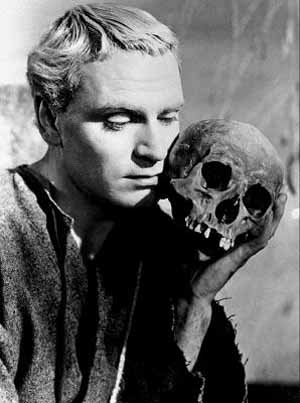
    Hamlet: You rang?!?

    Maybe, maybe not.

    See, like the best works of literature, a really well-written pop song actually lends itself to a wide array of thematic interpretations. Hamlet isn't *just* about doing right by your dead father. It's about finding one's place in the world. It's about searching within one's self for the answer to that all-important question posed in the very first lines of the play ("Who's there?"). And it's about taking the necessary time to discover what it means "To be, or not to be."

    Now sure, as is the case with great literary analysis, there's an "acceptable range" of what all a song *can* and *cannot* mean (example: when our buddy Matt sings "
    if I cannot follow where you go, I promise to teach what I have learned" -- he's probably not talking about eeking out life-lessons while tailing some dude on his way to a one-stall men's room. Well okay, maybe). But by and large? The songwriter has pretty much laid bare some universal themes here, and now it's up to us, the audience, to make sense of things.

    So let's do exactly that. And since we're obviously dealing with some heavy subject matter, let's do it by looking at this song as it relates to the similarly universal themes on human suffering and sadness, as once so famously put forth in the ever-handy "Kübler-Ross model" (a.k.a. -- the five stages of grief).

    Take it away, Wikipedia-level understanding of advanced psychological theories!

    Anger: ("Fortune smiles with teeth of jade, and the greediest eyes")Translation: "Greed. Argh! Boy, I'm pissed that you've been stolen away from me."
    Denial: ("How do years so far away so suddenly evaporate?")Translation: "Man, I can't believe this is actually happening."
    Bargaining: ("If you will go and not return / leave me some words of wisdom.")Translation: "Go if you must, but please -- one last thing before you do..."
    Depression: ("Who was it that said to me / that heroes would live forever?")Translation: "I'm a sad panda."
    Acceptance: (If I cannot follow where you go, I promise to teach what I have learned.")Translation: "Well, ok then. This sucks and it'll take time, but I'll try."
    Hey cool.

    The figurative language opens the song up so well that the songwriter's once intensely personal eulogy for his late father actually becomes a broader commentary on the universal themes of life, love, and loss. Suddenly (just like
    Hamlet), we're not just talking about the simple case of some dude who's trying to make peace with his dead father anymore.

    You want to follow, but you know you can't.

    You've given your all, but still you're left standing all alone.

    And even though you might well have accepted that things simply had to change, you're certainly not over it -- no sir, not by a longshot.

    (Damned ear poison)

    Wow. This just got deep in a hurry. Infinitely more universal, too. Heck, when you look at it *that* way -- one might even call this a tailor-made breakup song. And for a track that doesn't once mention the word "love" -- that's quite a feat. Crazy, right?

    Yay figurative language!

    (... now get thee to a nunnery...)

    2. The Scientist - (Coldplay)


    "I was just guessin' at numbers and figures / pulling the puzzles apart."
    Poor, poor Chris Martin.

    Sure, the guy might have ended up with Gwyneth Paltrow, but deep down? He's a total science dork. I mean seriously -- just look at how often the guy finds himself singing about outer space, "questions of science," and other similarly themed poindextery stuff:

    "Look at earth from outer space" (Politic)"You and me are drifting into outer space" (X&Y)"All of the stars and the outer space" (White Shadows)
    (In retrospect, this could explain the whole "virgin until his mid twenties" thing).

    But getting to the song at hand --

    We've got ourselves a scientist. And not just *any* scientist, mind you -- but "THE" Scientist. As in a guy who pretty much defines his entire self through his life's work. He's brilliant, probing (heh heh heh), coldly analytical -- and dangerously good at his job accordingly. After all -- a mind for "pulling the puzzles apart" is a must-have when dealing with "questions of science." Wouldn't you agree?
    Dr. Gregory House: Word, dawg.

    Ok -- so we've got ourselves this scientist, yes? And when it comes to solving analytical puzzles? Dude's a friggin' genius. But when dealing with matters of the heart?

    Not so much.

    Hmm -- a science dork who just can't seem to make sense of human relationships? Kinda' reminds me of another tortured genius with a Ph.D. from roughly 400 years earlier.
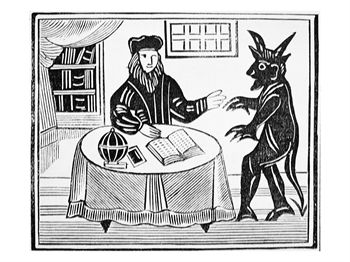
    The Tragical History of Doctor Faustus (1604)
    By Christopher Marlowe

    When it came to Elizabethan playwrites, there's no question that Billy Shakespeare was the man to beat. But if Shakespeare was the shit, then Marlowe was -- at the very least -- the urine (how's that for a colorful metaphor? Thanks, Kanye). And Marlowe's wildly controversial
    Faustus was pretty much the closest thing to Better-Than-The-Bard to have emerged from the whole of the 17th century.

    The story is simple:

    Dr. Faustus is a genius, but he's not satisfied with simply being the smartest guy in the room. Instead, he wants to be the smartest man IN THE WORLD, and so he makes a deal with the devil to trade his soul for exactly that. Mephistophilis (being the devil and all) is more than happy to agree -- and so he makes Faustus an uber-genius, but promises to steal him back to hell as per their agreement some 24 years later.

    Flash forward 24 years...

    Just as Mr. Fausty Pants is hitting his stride as "the smartest man in all the world," he comes across a total knockout of a ladyfriend (in the form of one Miss Helen -- of Troy fame). And whaddayaknow -- our forsaken superdork falls madly in love.

    (Wanna' guess how well *that* turns out?)

    How about we leave the summary to the immortal words of the good doctor himself:

    "Why this is hell, nor am I out of it.
    Think'st thou that I, who saw the face of God,
    And tasted the eternal joys of heaven,
    Am not tormented with ten thousand hells
    In being deprived of everlasting bliss?"
    Ooooh, BURRRRN!!! (literally)

    Or as our good friend Chris Martin might say --
    "Tell me you love me, come back and haunt me..."

    Just when you think you've got all the important stuff figured out, love comes in and changes the questions. Boy it sucks to be you, Faustus (and that goes double for The Scientist). But unlike Marlowe's hell-bound physician, Coldplay's lovesick scientist actually has a brief chance at redemption. As he sings:


    "Nobody said it was easy
    [but] no one ever said it would be this hard
    I'm going back to the start."
    In other words: when your world falls down, take a good, hard look in the mirror and get right with yourself.

    Aww, that's nice.

    Too bad it's blatantly cribbed from Yeats:

    "Now that my ladder's gone,
    I must lie down where all the ladders start
    In the foul rag and bone shop of the heart."

    - William Butler Yeats, "The Circus Animals Desertion" (1939)
    (Why they even borrowed the whole "heart" / "start" rhyme. How clever).

    Wait -- COLDPLAY?!? STEALING MATERIAL FROM OTHER ARTISTS, you say!?!

    Hey, songwriting's a tough bizniss. Or, in Chris Martin's own words:
    "Nobody said it was easy."